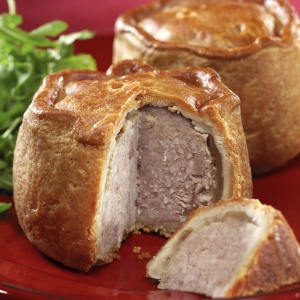
This is an awesome snack or even a whole meal on it's own. It is quite a long process to make one, but not at all difficult. It originates from Melton Mowbray in Leicestershire and the Melton Mowbray Pork Pie has protected status since 4 April 2008 meaning only Pork Pies made in Leicestershire East of the M1 may be called a Melton Mowbray Pork Pie.
Mary Dickinson (1768 - 1841) is credited with being the first person to create the hot water crust pastry in the now traditional method of using a wooden dolly to hand raise the casing. In the late 1800s fox hunters found them to be ideal snacks while out riding as they didn't break up in their pockets and so the legend spread down to London and beyond. Who cares about the history? Lets make and eat a pork pie.
There are 3 parts to making a proper (Melton Mowbray) pork pie. The pastry casing, the filling and the jelly. The trick is to get the casing right as this is what really makes the pie what it is. But lets start this recipe in the right order.
The Jelly is going to take the longest to make - the day before you start is ideal.
Ingredients
900g pork bones - or just use pig trotters only
2 pig's trotters - 4 if you are only using pig trotters
2 large carrots, chopped
1 onion, peeled, chopped
2 sticks celery, chopped
1 bouquet garni (bay, thyme, parsley, rosemary tied together with string)
½ tbsp black peppercorns
A few strands of agar agar if you can get it (try a Chinese speciality shop - agar agar keeps the jelly solid in very hot conditions)
Method
For the pork jelly, place all of the pork jelly ingredients into a large pan and pour in enough water to just cover. Bring slowly to the boil, then reduce the heat to a simmer. Cook for three hours over a low heat, skimming off any scum that rises to the surface, then strain the stock through a fine sieve and discard the solids.
Pour the sieved stock into a clean pan and simmer over a medium heat until the liquid has reduced to approximately 500ml/1 pint.
Basically you are essentially making a pork stock using Pigs trotters. I have seen a recipe that only calls for trotters and not bones as well. The key is using pigs trotters because that is where your jelly is going to come from. Otherwise just make a really tasty stock from the trotters. The idea of putting the stock in the fridge overnight is a great one as you get to see if the jelly will really set. If it doesn't boil it down a bit further. Otherwise get downright lazy and use a Knorr Stockpot and gelatine sheets / agar agar (found near the baking ingredients or Jellies / at a Chinese speciality shop)!
Next comes the filling
For the pie filling
400g/14oz shoulder of pork, finely chopped
55g/2oz pork belly, skin removed, minced
55g/2oz lean bacon, finely chopped - bacon bits work too as does chopping up a Kassler rib or two
½ tsp ground allspice
½ tsp freshly grated nutmeg
1 tsp of thyme
1 tsp of chopped rosemary
salt and freshly ground black pepper
Method
For the pie filling, place all of the pie filling ingredients into a large bowl and mix well with your hands. Season with salt and freshly ground black pepper.
I have seen all sorts of recipes but this has been by far the tastiest. You can add more herbs if you like, thyme, rosemary & sage are good Pork accompaniments. If you can't find pork belly (or it is too expensive) pork mince will be a good substitute. You might struggle to find Allspice in the run up to Easter because bakers are sticking it into hot cross buns.
For the casing
Ingredients
100 ml milk
125 g lard (Holsum)
250 g plain flour
pinch of salt
30 ml water
1 beaten egg, for brushing
Method
- Warm the milk and half the lard in a saucepan over a low heat until the lard has melted. Leave to cool (fairly important step!).
- Sift the flour and salt into a large mixing bowl. Cut the remaining lard into small pieces and add it to the flour
- Using your fingers gently rub the fat into the flour until it resembles breadcrumbs.
- Make a well in the middle of the flour and pour in the cooled milk mixture
- Mix together to a pliable dough. If the mixture is too dry add some water
I have found the majority of people recommend a 1:2 ratio of lard to flour and using only water is acceptable to using milk or a milk and water mix.
Now to make the Pork Pie!
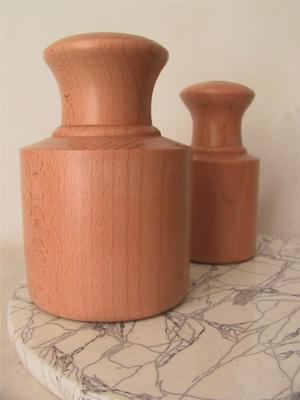
These are Pork Pie dollies. The big one is about 10 cm in diameter and the small one about 6 cm. This is how you use them.
How To Hand Raise A Melton Mowbray Pork Pie - http://www.youtube.com/watch?v=JRRRG9CdALo
Unless you know a friendly carpenter with a lathe you are unlikely to be able to lay your hands on a Dolly (eBay.co.uk and Amazon.co.uk has them in abundance, but then you may have a problem getting them to you in other parts of the World). I did find a soapstone "paperweight" with this sort of shape in a secondhand shop and snapped it up as it works very well, having obviously come from a bygone era when hand raising pies would have been more common.
Here is another way without a dolly. Exactly the same result with possibly a lot less fuss.
Quick hand raising of a pork pie without a dolly. - http://www.youtube.com/watch?v=B1wFsGtjKHQ
Having made your pie as per the videos, make two pencil sized holes in the top of the pie so you can put the jelly in later, give the outside an egg wash and stick it on a baking sheet and bake in a 180C oven for an hour to an hour and a half or until it is a golden brown colour all over.
Once cooked let it cool down completely before adding the jelly through one of the holes in the top. Jelly in one, air out the other. Let the jelly set and enjoy a wonderful snack food that goes well with cheese, pickles, piccalilli or chutney. Ma Balls is particularly good.